Travel With Confidence After 60: What Every Senior Needs to Know Before Flying in 2026
If you’re traveling after 60, preparation matters more than ever. Learn how to protect your money, understand airline rights, avoid reimbursement mistakes, and travel with legal and financial clarity in 2026.
Kim Kirkley, JD, MSW Senior Travel Rights Strategist Founder, SeniorSavvyTravel.com
3/2/20264 min read
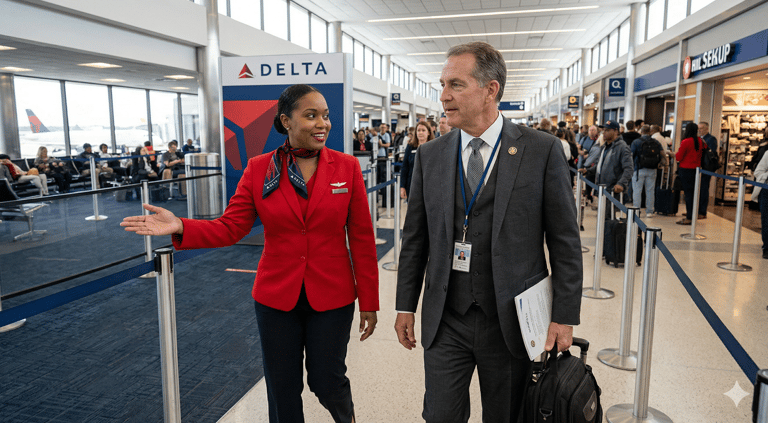
Delta Just Did What Congress Wouldn't
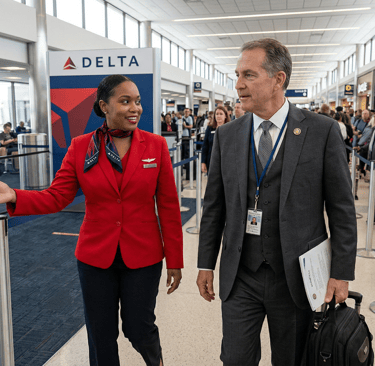
While TSA officers were showing up to work without a paycheck for the third time, members of Congress were still being escorted through airports by red-coated Delta agents — bypassing the same security lines their constituents were standing in for four, five, sometimes nine hours.
Then Delta did something Congress wouldn't.
On March 24, 2026, Delta Air Lines announced it was suspending its specialty services for members of Congress — the airport escorts, the priority handling, the VIP access that most Americans didn't even know existed. Lawmakers would now be treated like everyone else: based on their SkyMiles status, not their elected office.
One airline did in a press release what 535 lawmakers couldn't seem to do in months of negotiations.
What Most Travelers Don't Know
Before this week, members of Congress enjoyed a set of travel privileges that were never publicized, never voted on, and never explained to the public who funded them. Airport escorts. Red coat services. A dedicated Capital Desk for last-minute reservations and changes. The ability to bypass the TSA lines that regular travelers — including seniors with mobility challenges, families with young children, and essential workers — had to endure.
Meanwhile, the TSA officers staffing those checkpoints hadn't been paid in weeks.
The partial shutdown of the Department of Homeland Security began February 14, 2026. By late March, TSA employees had missed three full paychecks. Call-out rates soared — 40% in Houston, 37% in Atlanta. Lines at Hartsfield-Jackson stretched to nine hours on some days. Airports issued advisories telling travelers to arrive four hours early. Spring break travelers, including countless seniors who had planned and saved for these trips, sat on floors and missed connections.
Congress did not act.
TMZ, of All Places, Tried
In a moment that said everything, it was TMZ — not C-SPAN, not a Senate subcommittee — that launched a public pressure campaign. Cameras followed lawmakers into airports. Videos circulated of congresspeople traveling smoothly while their constituents couldn't get through security. The message was unmistakable: the people who create this chaos don't live in it.
And still, Congress did not act.
The Senate did pass a unanimous proposal, introduced by Sen. John Cornyn of Texas, to formally end the line-skipping privileges. A rare moment of bipartisan agreement. But the bill still needs House approval and a presidential signature before it becomes law.
Congress is now on break.
The Promise That Hasn't Materialized
President Trump has said he will sign an executive order to ensure TSA workers receive their back pay. That order has not been signed. And when it is, experts say it will likely take weeks for workers to actually see the money.
Weeks. For people who couldn't pay their bills in February.
These are the same workers we depend on to keep our airports safe. The same workers who showed up anyway, shift after shift, because the job requires it. The same workers who were handed food bank referrals instead of paychecks.
What This Means for Older Travelers
I work with travelers 60 and older every day. I hear from seniors who saved for a year to take a trip. Who travel with medications that can't be checked. Who use wheelchairs and mobility aids and need assistance that doesn't show up when staffing is at 60%. Who stand in four-hour lines because they don't know they have a legal right to request help.
The Air Carrier Access Act gives older travelers with mobility challenges, chronic pain, fatigue, or any condition that makes long waits unsafe the right to request assistance — from check-in through boarding. That right doesn't disappear during a shutdown. But it becomes harder to enforce when the people responsible for carrying it out are overwhelmed, underpaid, and working on empty.
When Congress fails to fund the TSA, it isn't an abstraction. It shows up in the body of a 72-year-old woman standing in line for two hours because she didn't know she could ask for a wheelchair. It shows up in the anxiety of a senior traveler who planned this trip for months and is now watching her connection disappear.
Delta's Message Was Loud
Delta framed the suspension as a resource decision. But the message was clear: if we have to choose between escorting lawmakers to their gates and taking care of our actual customers and our people, we're choosing our people.
That's a corporate statement that functioned as a moral one.
The Senate's unanimous vote to end congressional line-skipping — even if it hasn't become law — was notable. Senators from both parties agreed: the optics of VIP airport treatment during a TSA payment crisis were indefensible.
But optics aren't the same as action. And a vote that stalls in the House while Congress goes on recess isn't relief — it's a press release.
The Dignity Gap Is the Story
For years, I've been saying that how we treat travelers at airports is a reflection of how we treat people — particularly older people, people with disabilities, and people without access to workarounds and workarounds.
The congressional travel privileges weren't just unfair. They were a working model of a two-tiered system: one for the powerful, one for everyone else. The TSA underpayment crisis made that visible in real time.
Delta pulled back the curtain. The Senate acknowledged the problem. The House has not acted. The executive order hasn't been signed. The back pay hasn't arrived. And Congress is on vacation.
Meanwhile, older travelers are still navigating airports that are understaffed, overstressed, and unprepared for what's coming this summer if nothing changes.
What You Can Do Right Now
If you're flying and you need assistance — wheelchair service, early boarding, help navigating a long line — you are legally entitled to ask for it. You do not need to explain your diagnosis. You do not need to prove anything. The Air Carrier Access Act protects you.
Say this: "I have a condition that makes standing in long lines unsafe. I am requesting accommodation under the Air Carrier Access Act."
Say it clearly. Say it calmly. And know that federal law is behind you — even when Congress isn't.
Kim Kirkley, JD, MSW, is a retired attorney, travel rights educator, and founder of SeniorSavvyTravel.com. She helps travelers 60+ navigate the air travel system with confidence, dignity, and the law on their side.